Support engineering article
AI support automation vs investigation: what actually reduces escalations
AI support automation improves speed on repetitive work. Investigation-first systems reduce the expensive technical escalations that keep pulling in engineering.
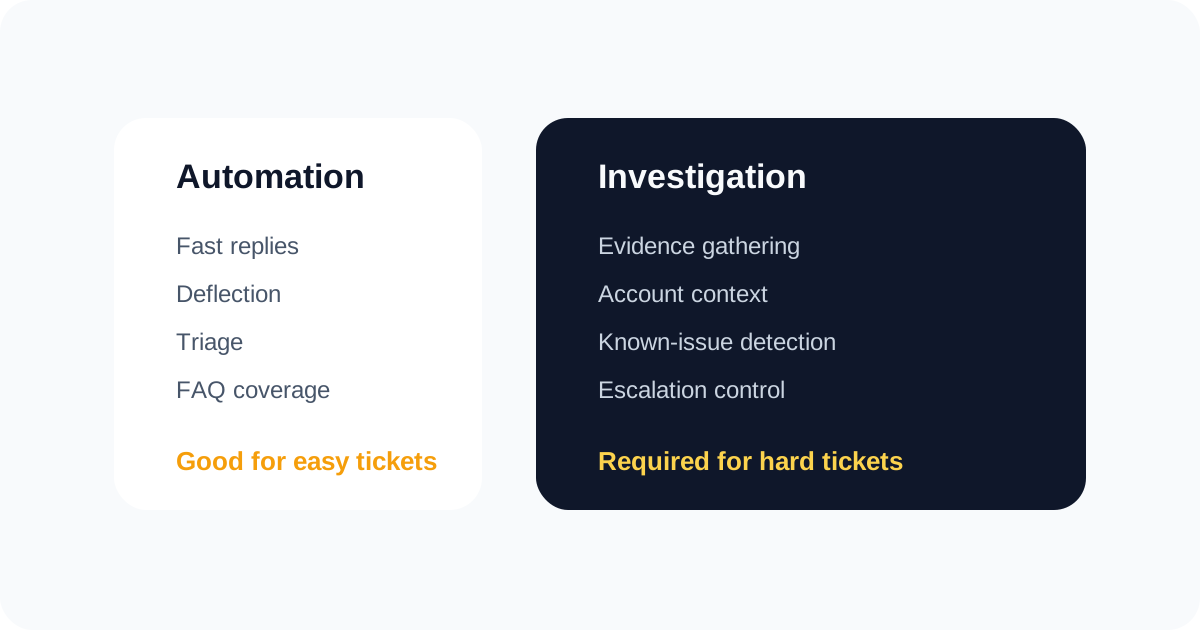
Most teams buy AI support automation and expect investigation outcomes. That is the category mistake. Automation makes the obvious work faster. Investigation makes the expensive work clearer. If you confuse the two, the rollout looks good in the dashboard and disappointing in the tickets that keep dragging engineering into support.
The question is no longer whether AI can automate support tasks. Intercom, Zendesk, and Ada have already made that standard category language. The real question is which part of support you are trying to improve: repetitive execution, or technical truth-finding.
What is AI support automation?
AI support automation is the use of AI to speed up repeatable support tasks such as ticket classification, routing, FAQ handling, macro generation, translation, and reply drafting. It is valuable because it reduces manual effort on work with known patterns.
Automation is useful. It is just not the whole support problem.
What is AI support investigation?
AI support investigation is the use of AI to help support understand what actually happened in the product before the answer is written. That includes clarifying the issue, gathering internal context, surfacing relevant evidence, testing likely explanations, and deciding whether escalation is really necessary.
That is a different job from response drafting. It happens earlier, and it matters more on the tickets that cost the team the most.
Why support teams keep confusing the two
The confusion is understandable. Automation is easier to demo, easier to buy, and easier to explain to executives.
It produces quick wins:
- faster first response times;
- lower manual triage load;
- more consistent handling of repetitive requests;
- cleaner apparent labor savings.
Investigation wins are slower and more operational. They show up in:
- fewer unnecessary escalations;
- faster time to first evidence;
- better technical answers;
- less repeated internal lookup work.
One set of wins is visible immediately. The other changes the economics of the hard queue. That is why teams often overinvest in the first and underbuild the second.
This distinction is close to Google's SRE framing of toil: repetitive operational work can consume a team even when every individual task looks small. Automation can reduce that kind of work, but investigation is what changes whether the remaining hard tickets get solved with better judgment.
What automation is actually good at
Automation is strongest when the case already has a stable path.
That usually includes:
- classifying ticket type;
- suggesting or sending known answers;
- routing the case to the right queue;
- collecting basic intake fields;
- closing simple repetitive requests faster.
These are real gains. They are not cosmetic. They remove friction from the easiest part of the support system.
Competitors do this well in different ways. Intercom is strong at AI-first support narratives. Zendesk is strong at broad workflow and service coverage. Ada remains strong in automated resolution framing. The problem is not that those capabilities are weak. The problem is assuming they solve the deeper investigation gap by default.
What automation usually does not solve
Automation alone does not tell support why a specific tenant stopped receiving webhook events after a configuration change. It does not tell the team whether a permission migration caused a blank settings page. It does not automatically determine whether a suspicious behavior is a bug, a stale state issue, an expected edge case, or a customer workflow mistake.
That is investigation work.
It depends on:
- case reconstruction;
- account and event context;
- recent product changes;
- likely-cause evaluation;
- routing discipline.
If the AI layer does not help with those steps, the support team may answer faster on easy tickets while still escalating the same technical tickets as before.
Webhook support is a useful concrete example. GitHub's webhook troubleshooting docs show that the right next step depends on the failure mode: missing delivery, failed connection, timeout, invalid response, out-of-order delivery, or signature verification. A reply generator cannot replace that classification work.
Investigation is what actually reduces escalations
Technical escalations rarely happen because support could not write a response. They happen because support could not determine what was true.
That is why investigation matters more than many teams expect. Investigation changes whether the support team can:
- identify expected behavior and explain it confidently;
- isolate configuration mistakes without engineering;
- distinguish platform issues from product defects;
- send a much cleaner escalation when engineering is truly needed.
This is the same logic behind Engineers keep getting pulled into support. The interrupt problem usually starts before the escalation. It starts when the team lacks a reliable path for gathering and interpreting evidence.
Google's Effective Troubleshooting chapter is a useful reference because it treats troubleshooting as hypothesis testing against telemetry, logs, and system knowledge. That is the investigation layer support teams need AI to accelerate.
| Dimension | Automation | Investigation | Why the difference matters |
|---|---|---|---|
| Primary job | Execute repeatable support motions faster | Understand what happened before answering | Different bottlenecks require different systems |
| Best ticket types | FAQ, routing, known processes, repetitive requests | Ambiguous technical, account-specific, or high-risk cases | The hard queue is where escalations usually begin |
| Main success metric | Response speed, containment, manual effort reduction | Time to first evidence, escalation reduction, answer quality | Good-looking speed metrics can hide a weak investigation path |
| Failure mode | Answers quickly but shallowly | Searches too broadly without narrowing | One creates false confidence, the other creates slow analysis |
| Engineering impact | May not reduce interrupts on technical tickets | Can materially reduce avoidable engineering pulls | Support economics change on the expensive work |
Framework comparison of two distinct AI support capability categories.
How to tell which problem your team actually has
This is the practical buying question.
Ask:
- Are we overwhelmed by simple repetitive tickets, or by ambiguous technical tickets?
- Does support already know the answer but spend too much time delivering it?
- Or does support lack the facts required to decide what the answer should be?
If the first problem dominates, automation is the higher-leverage starting point.
If the second and third dominate, investigation is probably the bigger gap.
Most mature B2B support teams eventually need both. The mistake is assuming the first automatically delivers the second.
What changes when teams build for investigation first
Investigation-first support systems behave differently in operation.
They:
- normalize the intake so the problem statement is clear earlier;
- gather the minimum useful context instead of broad undirected data;
- produce explicit hypotheses before routing;
- improve escalation quality because the hard work started before the handoff;
- make customer responses more defensible because the answer follows evidence.
That is why the workflow on Build AI support workflows that resolve tickets faster starts with intake and investigation rather than response drafting.
The output looks less magical in a demo. It works better in a real queue.
Where to start if engineering still gets dragged into support
Do not start by asking AI to "handle more support." Start with one ticket class that repeatedly pulls in engineering.
Then build:
- a stable intake schema for that case type;
- an investigation checklist for the evidence that matters;
- a routing decision model for explainable versus escalatable cases;
- a handoff packet for the cases that still need engineering.
This is exactly where:
- Support investigation checklist for faster technical answers
- Technical support escalation process for complex tickets
- L2 support process for technical support teams
become more useful than another generic AI support feature comparison.
The strongest AI support stack uses both, but in the right order
Automation and investigation should work together. The ordering matters.
The best sequence usually looks like:
- automation cleans intake, routing, and repetitive work;
- investigation handles the hard cases by gathering context and narrowing causes;
- response drafting happens after the case is understood;
- escalation happens only when the remaining gap is real.
That is how support becomes more autonomous instead of merely more responsive.
FAQ
Is AI support automation enough for most teams?
It is enough for teams whose main pain is repetitive support work. It is not enough for teams whose cost and customer risk live in technical investigation and escalation quality.
What is the clearest sign that a team needs investigation more than automation?
Engineering still gets pulled into the same routine technical questions even after response speed improves. That usually means the front of the queue got faster while the truth-finding workflow stayed weak.
Can one platform do both automation and investigation?
Possibly, but you should evaluate those capabilities separately. Many products market both under the same AI label even though they solve very different support bottlenecks.
How does Lumen frame this differently?
We start from the hard queue. If AI cannot help support gather evidence, narrow likely causes, and send cleaner escalations, the system may look modern without making technical support materially stronger.
Related reading
Continue through the archive
Adjacent articles that expand the same operating model from a different angle: workflow design, investigation quality, and escalation control.
May 15, 2026
AI support metrics that actually matter
Most AI support dashboards reward speed, containment, and cost reduction. The better scorecard measures resolution quality, escalation health, and support autonomy.
May 14, 2026
Support operations for technical tickets
Support operations for technical tickets should define queue design, investigation workflow, escalation quality, and feedback loops that reduce repeat effort.
May 13, 2026
Technical customer support troubleshooting without engineering bottlenecks
Technical customer support troubleshooting works best when support translates symptoms into evidence-backed case decisions before escalation.