Support engineering article
Why AI support escalations tank NPS even when resolution rates look good
AI support dashboards can look healthy while escalated customers have a much worse experience. The gap is usually in the handoff, not the bot alone.
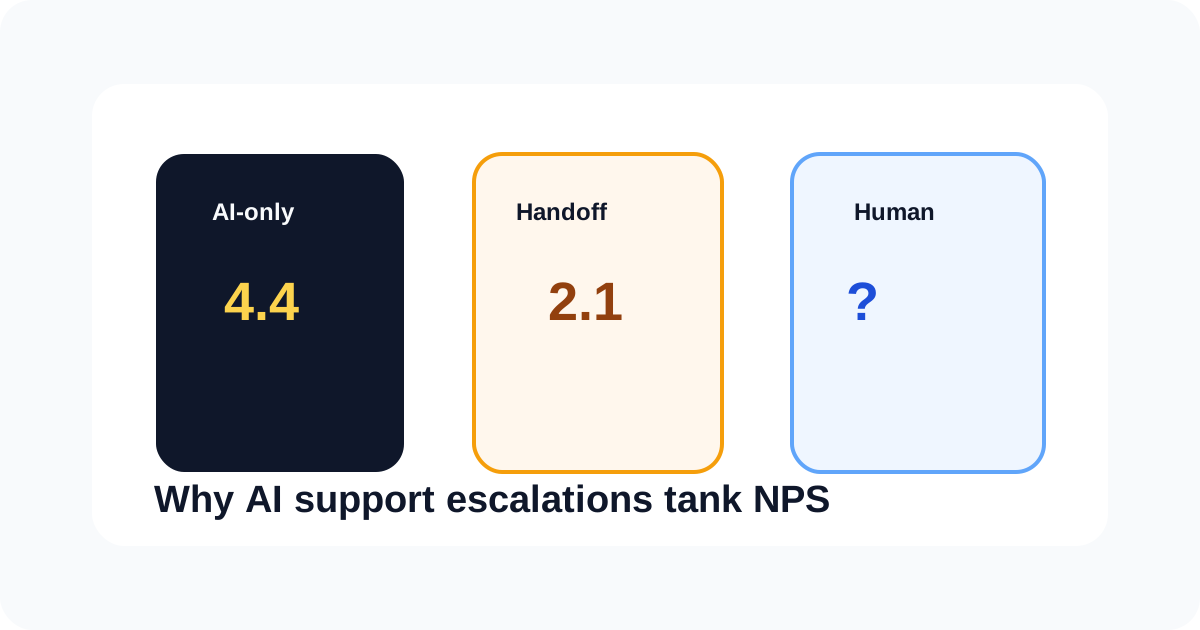
AI support does not usually fail on the first reply. It fails on the handoff. That is why a support team can improve resolution rates, celebrate a cleaner AI dashboard, and still watch NPS or CSAT fall on the conversations that actually matter most.
The question is no longer whether AI can answer simple support requests. Intercom, Zendesk, and Ada have already proved that part of the market. The real question is which systems keep customer trust intact when the AI path stops being enough and a human has to take over.
What is an AI support escalation?
An AI support escalation is the moment when a conversation stops being AI-resolved and becomes human-owned. In practice, it is not just a queue transfer. It is a continuity test.
If the handoff preserves context, the customer experiences one support journey. If the handoff drops context, the customer experiences two disconnected systems and judges the second one much more harshly.
Why AI support scores look healthy while NPS drops
The answer is simple: most teams are averaging together two different experiences. The AI-only path is fast, clean, and easy to optimize. The escalated path is slower, more emotional, and usually more operationally expensive.
When those two paths are blended into one top-line metric, the easy path flatters the dashboard while the hard path quietly damages trust. The score improves at the same time the customer memory of support gets worse.
This is where many AI support programs become misleading internally. Leadership sees:
- faster first response times;
- higher containment or resolution on simple requests;
- lower apparent ticket cost.
Customers in escalated conversations experience:
- repeated explanations;
- colder human takeovers;
- longer time to a useful answer;
- more obvious internal confusion.
Those two realities can coexist for a long time if the reporting model is wrong.
The handoff is the real product surface
Most teams still treat escalation like a routing event. It is not. It is a support product surface.
That matters because the customer does not separate “what the bot did” from “what the human did.” They remember whether the company understood the problem, whether progress resumed quickly, and whether the next person seemed informed.
If the AI escalates without carrying enough context, the customer pays for it immediately. If the human agent cannot see what the AI already tried, the customer pays again. If the team cannot explain why the AI escalated, the handoff feels arbitrary rather than intelligent.
| Handoff gap | What the agent experiences | What the customer experiences | Operational consequence |
|---|---|---|---|
| No conversation history | The agent enters cold | The customer repeats the issue | Longer time to first useful reply |
| No record of prior AI attempts | The agent retraces already-failed steps | The interaction feels circular | More friction before real investigation starts |
| No sentiment or frustration signal | The agent underestimates the emotional state | The customer feels unseen | Lower post-case satisfaction |
| No confidence or failure reason | The agent cannot tell why the bot escalated | The handoff feels random | Misroutes and slower resolution |
| No structured evidence payload | The agent still has to discover the basics | The transition feels like a reset | Escalated resolution time grows sharply |
Framework table for diagnosing AI-to-human support handoff failures.
The strongest AI support systems understand this. Intercom is increasingly explicit about AI-first workflows. Zendesk emphasizes omnichannel AI resolution. Ada pushes AI resolution hard. But the market still spends more time selling the AI interaction than dissecting the human recovery path after the AI interaction fails.
That gap is exactly where support trust is won or lost.
Why escalated conversations are more fragile than AI-only conversations
Escalated conversations are not just “harder tickets.” They are already emotionally degraded when the human takes over.
By the time a case escalates, one or more things have usually happened:
- the customer already expected the AI to help and it did not;
- the conversation has already consumed some time without resolution;
- the customer may already be skeptical about whether the company understands the issue;
- the human is inheriting a problem that is likely more technical, more ambiguous, or more urgent.
That means the human takeover is a recovery moment, not a neutral start. If the recovery moment is weak, the trust score drops faster than teams expect.
This is especially true in technical support. A billing FAQ can survive a mediocre handoff. A permissions bug, webhook failure, broken sync, or product-behavior question usually cannot. Those cases require context and investigation, not just politeness.
Which metrics actually expose the problem
The first fix is measurement. If the scorecard is wrong, the diagnosis will be wrong too.
Teams should stop asking “is AI support working?” in aggregate and start asking “which support path is working, and which one is damaging trust?”
At minimum, most teams should separate:
- AI-only resolved conversations;
- AI-initiated conversations that escalated to a human;
- human-only conversations that never touched the AI layer.
Once that segmentation exists, the real operational metrics become easier to see.
| Metric | Definition | Why it matters | Failure signal |
|---|---|---|---|
| Escalated-path CSAT or NPS | Satisfaction segmented only for AI-to-human cases | Shows whether the handoff damages trust | Large gap vs AI-only path |
| First human useful reply time | Time until the customer receives a contextual human answer | Captures real recovery speed | Fast first reply but slow first useful reply |
| Customer re-explanation rate | Share of escalations where the customer must restate the problem | Measures continuity directly | High repeat burden on the customer |
| Escalation rework rate | Share of escalations missing key context or evidence | Measures packet quality | Agents ask for basics already available earlier |
| Agent recovery effort | Extra investigation work required because the AI handoff was weak | Shows hidden labor cost | Human queue becomes harder without better context |
Framework metrics for the escalation segment only. These should not be blended back into AI-only reporting.
These metrics matter more than containment alone because they tell you whether the AI helped the human system or simply pushed easy work out of the way while leaving the hard path more brittle.
This is also where AI support metrics that actually matter becomes a better reference point than a generic automation dashboard. The right scorecard should preserve the truth of the workflow, not flatten it.
What a strong AI-to-human escalation should carry forward
A good escalation should feel like one conversation continuing with a better-equipped participant. It should not feel like the customer has been dropped into a second support system that knows less than the first one implied.
At minimum, the handoff should usually carry:
- the complete conversation history;
- the issue summary in plain language;
- the account, workspace, or user identifiers;
- what the AI already tried;
- why the AI escalated;
- any evidence already gathered;
- signals about urgency, frustration, or likely cause.
That payload is not a nice-to-have. It is the difference between a human starting at step two versus a human restarting at step zero.
This is why the case-packet logic in Technical support escalation process for complex tickets matters so much. The upstream actor may be an AI layer, but the handoff still lives or dies on the same principle: move context, evidence, and the open question together.
Competitors have improved the first reply. The bigger gap is still recovery
The AI support category is getting much better at the first reply. That should be acknowledged plainly.
Intercom has done a good job of making AI-first support feel operationally real rather than speculative. Zendesk has the distribution and reporting footprint to normalize AI in mainstream support teams. Ada has built much of its positioning around automated resolution and AI-led service delivery.
The unresolved problem is not whether those systems can answer straightforward requests. It is whether the surrounding workflow protects the harder conversation after the AI path ends.
That is where Lumen’s angle is more specific. We care less about whether the first response sounds polished and more about whether the system helps support arrive at the right technical answer with enough evidence. On harder tickets, that difference matters more than the speed of the first bot message.
What support leaders should review every week
Most teams do not need a giant reporting rebuild on day one. They need a weekly handoff review that reveals where continuity breaks.
| Question | What a strong answer looks like | What a weak answer suggests |
|---|---|---|
| Did the agent have the full thread? | Yes, with readable history | The handoff starts from a partial record |
| Did the agent know what the bot already tried? | Yes, without digging manually | The agent repeats already-failed steps |
| Did the escalation include a likely reason? | Yes, with confidence or failure context | The human enters blind |
| Did the customer need to repeat themselves? | Rarely | Continuity is broken |
| Did the first human message move the case forward? | Yes, it acknowledged context and next steps | The reply looked generic or reset the interaction |
Framework table for qualitative handoff review. Use it alongside segmented customer satisfaction.
That review is usually more useful than another broad automation KPI because it puts the team in direct contact with the part of the workflow that customers remember most negatively.
The fix is not less AI. It is better continuity
When NPS drops after an AI rollout, the lazy explanation is that “customers hate bots.” Sometimes they do. But that explanation is too shallow for most support teams trying to run serious operations.
The more useful explanation is usually:
- the easy path improved;
- the hard path was under-instrumented;
- the human takeover was weaker than the AI implied it would be;
- the customer judged the whole experience as one failed continuity chain.
That is fixable. But the fix lives in workflow design, not just bot prompt tuning.
FAQ
Does AI support always lower NPS when a case escalates?
No. AI support lowers NPS on escalated cases when the handoff is weak. If the transition preserves context, carries evidence, and gets the human agent to a useful answer quickly, escalations do not have to damage trust.
What metric should teams check first if they suspect a handoff problem?
Start with segmented satisfaction for AI-to-human cases. Then check customer re-explanation rate and first human useful reply time. Those usually reveal the continuity problem faster than broad resolution dashboards.
Is containment rate still useful?
Yes, but only in context. Containment can show whether the AI layer handles simple requests efficiently. It does not show whether the escalated path remains healthy.
Why are technical support teams hit harder by weak AI escalations?
Because technical tickets require investigation. If the handoff drops context, the human agent has to reconstruct the case before they can even begin the real work.
Where does Lumen fit into this problem?
Lumen is built around the investigation layer that usually breaks during weak escalations. The goal is not only faster replies. The goal is better context, better evidence, and better human takeovers when the hard ticket shows up.
Related reading
Continue through the archive
Adjacent articles that expand the same operating model from a different angle: workflow design, investigation quality, and escalation control.
May 15, 2026
AI support metrics that actually matter
Most AI support dashboards reward speed, containment, and cost reduction. The better scorecard measures resolution quality, escalation health, and support autonomy.
May 14, 2026
Support operations for technical tickets
Support operations for technical tickets should define queue design, investigation workflow, escalation quality, and feedback loops that reduce repeat effort.
May 13, 2026
Technical customer support troubleshooting without engineering bottlenecks
Technical customer support troubleshooting works best when support translates symptoms into evidence-backed case decisions before escalation.