Support engineering article
Why B2B SaaS support stacks keep breaking down
Many B2B SaaS teams assemble support across CRM, helpdesk, CS, analytics, and AI layers, then wonder why the workflow still feels brittle.
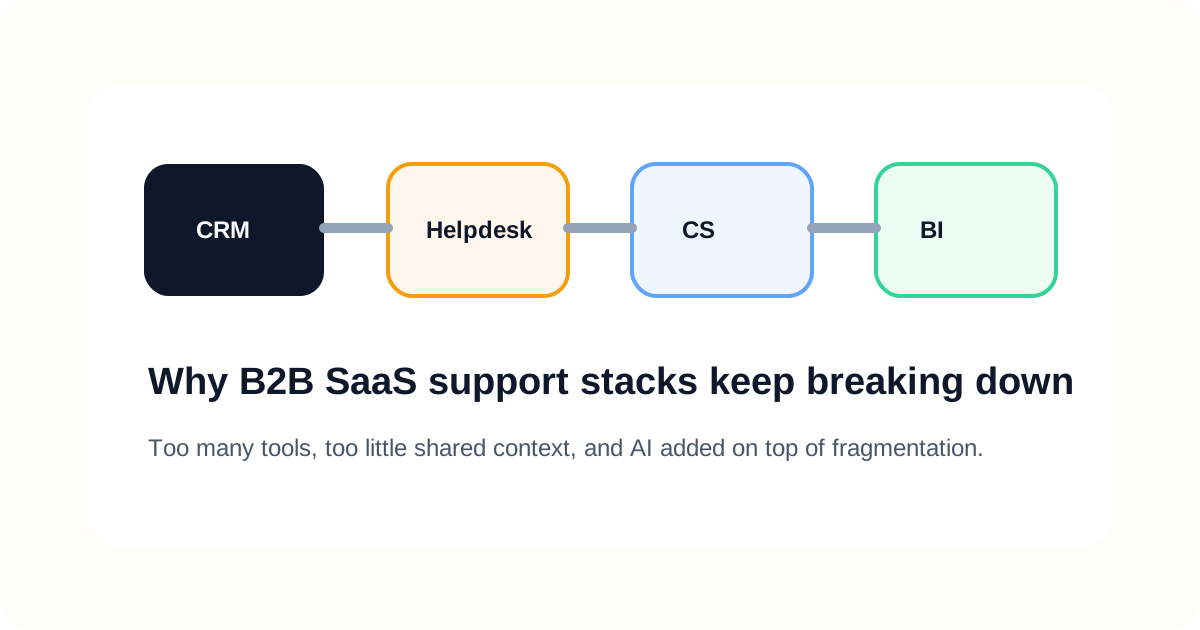
B2B SaaS support stacks usually do not break because teams bought the wrong single tool. They break because the company assembled several reasonable tools without ever defining one coherent support workflow across them.
The debate is no longer whether support needs CRM context, ticketing, customer success data, analytics, and AI. Of course it does. The question is which teams have turned those systems into one operating model and which teams are still pretending adjacent tools are the same thing as integrated support.
What is a B2B SaaS support stack?
A B2B SaaS support stack is the set of systems a company uses to understand the customer, manage the case, gather evidence, coordinate ownership, and measure outcomes. In practice, that usually includes a CRM, a helpdesk, internal communication channels, product analytics, and now some form of AI layer.
The problem is that most companies treat those systems as an inventory list rather than a workflow. That is why the stack keeps growing while the support experience keeps feeling more fragile.
Why the stack gets heavier as the company grows
Most B2B SaaS companies do not start with a giant support architecture. The complexity arrives incrementally.
The GTM team wants cleaner account visibility, so CRM becomes more central. Support wants better ticketing and automation, so the helpdesk deepens. Customer success wants lifecycle and health context, so another system appears. Product and ops want usage signals, so analytics and warehouses join the picture. Then AI arrives and gets asked to make the whole system feel simpler than it actually is.
Every individual decision makes sense. The problem is that the workflow is rarely redesigned at the same speed as the tool stack.
That is how companies end up with a support system that looks sophisticated on a buying map and awkward in execution. Agents still chase basics. Success teams still keep context elsewhere. Escalations still feel thin. Reporting still depends on someone reconciling partial truths from several systems.
Why AI feels harder in a fragmented support environment
AI does not remove fragmentation automatically. It inherits it.
If account context lives in one place, case history in another, product evidence in another, and business risk in another, the AI layer becomes one more participant in a scattered system. It may respond quickly on easy requests and still fail exactly where the company wanted leverage most: technical, account-specific, investigation-heavy conversations.
That is why AI feels deceptively good in demos and frustrating in real B2B support environments. It is often being judged on the one part of the workflow that was already easiest to improve.
This is where the category language from Intercom, Zendesk, and Help Scout is useful but incomplete. Those companies do a good job talking about automation, agent productivity, and AI-enabled service. The harder operational question is what happens when the answer depends on joined-up context across the stack, not just a quick conversational response.
Tool sprawl is a symptom, not the disease
It is easy to blame the problem on “too many tools.” Sometimes that is directionally true. But tool count alone is not a good diagnosis.
Two companies can run the same number of systems and have very different outcomes. One feels smooth because ownership is clear, context moves reliably, and the case lifecycle is defined. The other feels chaotic because each system is treated as a destination instead of a stage inside one support journey.
| Layer | What teams expect | What often happens instead | Operational consequence |
|---|---|---|---|
| CRM | Rich account context for every support case | Support context is present but not routed cleanly into the ticket workflow | Agents still chase account basics manually |
| Helpdesk | Queue management and case execution | The queue becomes the visible surface but not the real source of truth | Investigation happens in side channels |
| CS platform | Lifecycle and risk context | Customer health sits near support but not inside the support decision path | Escalations miss account-level business context |
| Analytics / warehouse | Usage and product evidence | Data exists but is too slow or too technical for the frontline workflow | Agents wait on someone else to interpret it |
| AI layer | Faster answers and better routing | The AI inherits fragmented context and escalates awkwardly | Simple cases improve while technical cases stay brittle |
Framework table for diagnosing support-stack fragmentation in B2B SaaS teams.
Once you see the stack this way, the strategy changes. The question stops being “which support platform should we buy next?” and becomes “what case lifecycle are we trying to make coherent?”
The hidden costs are mostly operational, not software costs
Software spend is the visible part of the problem. The more expensive part is usually operational drag.
Fragmented stacks create:
- more time spent chasing context;
- weaker support-to-success alignment on account state;
- weaker escalation packets into engineering;
- reporting that is technically complete but strategically untrustworthy;
- AI performance that looks good only on the easiest path.
Those costs compound. The company adds more process to compensate for fragmented tools. Then it adds more tooling to compensate for the process friction. Then AI is expected to simplify the system on top of all of that.
This is why support leaders often feel something important before they can articulate it: the stack is functioning, but the workflow is not stable.
What a coherent support system actually needs
A coherent B2B SaaS support system does not require one vendor. It requires one case model.
That case model usually needs:
- a single narrative of what happened;
- reliable customer and account identifiers across systems;
- a clear standard for what evidence must exist before escalation;
- visible current ownership and prior actions;
- reporting that follows the customer journey instead of the tool boundary.
This is the same reason L2 support and escalation quality matter so much. The strongest teams are not better because they have more dashboards. They are better because the case moves through a cleaner investigation path. That is the logic behind L2 support process for technical support teams and Technical support escalation process for complex tickets.
When should a team consolidate and when should it orchestrate?
Not every fragmented stack should be replaced. Sometimes replacement is just expensive motion. The better question is where the company is losing coherence.
| Condition | Better move | Why |
|---|---|---|
| Multiple tools but a stable workflow | Orchestrate better | The main problem is context movement, not tool count |
| Different teams need specialized systems | Orchestrate better | Replacement may reduce function-specific depth without fixing workflow design |
| Support teams live in side channels because the core systems cannot hold the real case state | Consider consolidation | The visible stack is not supporting the actual work |
| Reporting is irreparably split across systems | Consider consolidation | Leadership cannot steer well without a coherent measurement layer |
| AI adoption is blocked because the system cannot present one joined-up case context | Fix workflow first, then decide on consolidation | AI magnifies workflow quality problems rather than solving them automatically |
Framework table for deciding whether the problem is too many systems or weak workflow orchestration across them.
This distinction matters because a lot of companies buy a new platform to escape complexity and then recreate the same complexity inside a new surface area. If the workflow is still vague, the new stack becomes the old stack with a cleaner login screen.
Why support and customer success get merged badly
One of the most common workflow mistakes in B2B SaaS is talking about “support and success” as if they are the same operating function long after the company is too complex for that assumption.
Support usually needs:
- fast case handling;
- technical investigation paths;
- queue and escalation discipline;
- product evidence close to the workflow.
Customer success usually needs:
- relationship management;
- account planning;
- adoption and renewal context;
- longer-horizon commercial signals.
They absolutely need shared context. But they do not need the same workflow for every case. When a company never clarifies where one function ends and the other begins, the tool stack mirrors that ambiguity. Support tickets become account-management threads. Success systems become awkward case-management layers. AI lands in the middle and is expected to reason across a workflow the company itself never defined.
What leaders should audit before buying anything else
Before adding another tool, most leaders should run a workflow audit instead of a vendor search.
| Question | Why it matters | Bad answer suggests |
|---|---|---|
| Can a new support owner understand the case without checking three other systems? | Tests case continuity | The workflow has no reliable case narrative |
| Does the AI layer have the same customer context the human team relies on? | Tests whether AI can participate meaningfully | AI is bolted onto a fragmented foundation |
| Are escalations packaged with evidence or just forwarded with urgency? | Tests operational maturity | The system depends on manual heroics |
| Can support and success see the same account state at the moment it matters? | Tests cross-functional alignment | Customer context is split or stale |
| Can leadership measure support quality without reconciling several partial reports? | Tests reporting coherence | The stack cannot produce one trustworthy operating picture |
Framework table for support-stack audits in B2B SaaS organizations.
If several answers are weak, the company probably does not have a tooling problem alone. It has a support design problem.
The companies that look smooth have usually solved the workflow first
This is the part the market often underexplains. The best support organizations are not necessarily the ones with the fewest tools. They are the ones that have defined:
- where case ownership lives at each stage;
- what context has to travel with the case;
- which evidence matters before escalation;
- how support and success share account reality;
- how AI fits into the workflow without pretending to replace it.
That is why we think the real leverage is in the investigation layer, not just the reply layer. A stitched-together stack can still perform if the case model is clear. A modern-looking stack can still fail if the company is guessing its way through the handoff between systems.
The AI opportunity is still real, but only after the workflow is coherent
This does not mean AI is the wrong direction. It means AI works best when the support system already has a clean path for case context, evidence, routing, and ownership.
Once those foundations exist, AI can help with:
- intake normalization;
- evidence gathering;
- historical pattern lookup;
- response drafting from verified context;
- more consistent escalation packets.
This is exactly what Lumen is built around. We are not trying to add one more disconnected intelligence layer to a fragmented support stack. We are trying to make the investigation path itself more coherent.
FAQ
Do B2B SaaS support teams usually have too many tools?
Sometimes. More often, they have too little workflow clarity across the tools they already use. Tool count becomes a problem when the case lifecycle is undefined.
Should a company consolidate onto one support platform?
Not automatically. If the workflow is clear and context moves reliably, orchestration may be enough. Consolidation makes more sense when the current systems cannot hold the real case state or the reporting model is irreparably fragmented.
Why does AI feel harder to deploy in B2B SaaS support than in consumer support?
Because B2B cases often depend on account context, product behavior, permissions, contract realities, and technical investigation. AI inherits the stack fragmentation around those questions unless the workflow is already coherent.
Where should support and customer success share context most tightly?
At the account state, escalation, and risk layers. They do not need to become one workflow, but they do need a shared view of the customer at the moment a case becomes commercially important.
Where does Lumen fit into a fragmented support stack?
Lumen fits in the investigation layer. The goal is to make support and escalation workflows more coherent by improving the way evidence, context, and technical reasoning move through the case.
Related reading
Continue through the archive
Adjacent articles that expand the same operating model from a different angle: workflow design, investigation quality, and escalation control.
May 15, 2026
AI support metrics that actually matter
Most AI support dashboards reward speed, containment, and cost reduction. The better scorecard measures resolution quality, escalation health, and support autonomy.
May 14, 2026
Support operations for technical tickets
Support operations for technical tickets should define queue design, investigation workflow, escalation quality, and feedback loops that reduce repeat effort.
May 13, 2026
Technical customer support troubleshooting without engineering bottlenecks
Technical customer support troubleshooting works best when support translates symptoms into evidence-backed case decisions before escalation.