Support engineering article
Why AI support escalations tank NPS even when resolution rates look good
AI support dashboards can look healthy while escalated customers have a much worse experience. The gap is usually in the handoff, not the bot alone.
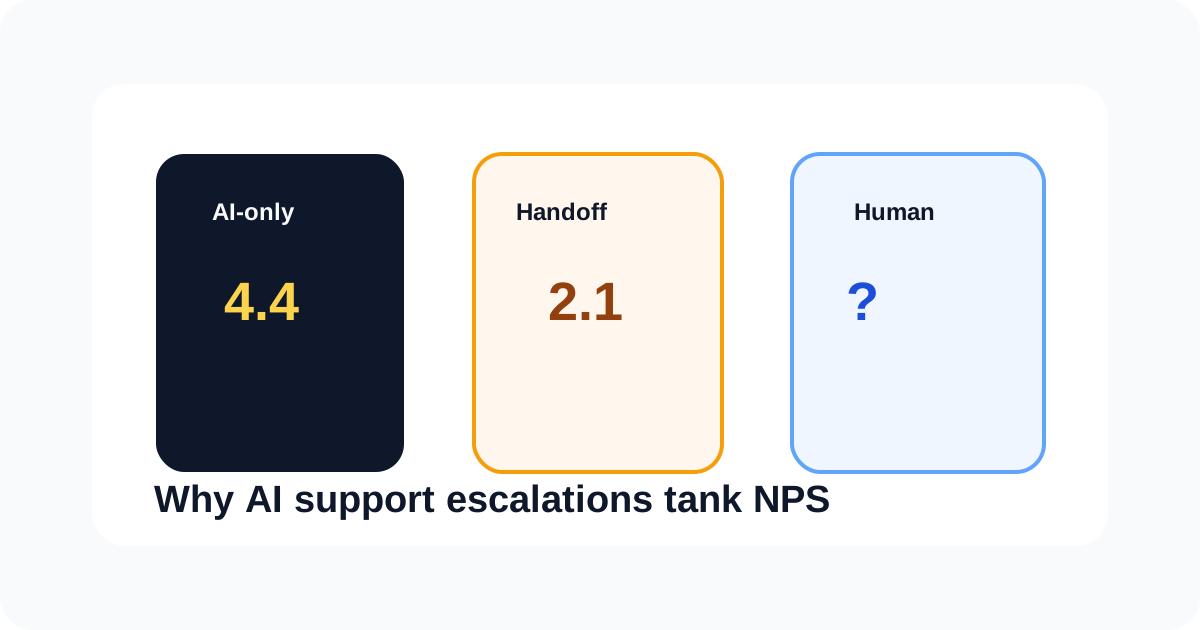
AI support escalations can tank NPS even when your dashboard says the system is working. That sounds contradictory until you split one blended support experience into its actual parts. The AI may perform well on the conversations it fully resolves, while the escalated cases degrade so badly that the overall trust in support drops anyway. When that happens, the problem is usually not just the bot. It is the handoff between AI and human support.
That pattern keeps surfacing in public support discussions. One recent Reddit thread described a team that reached a solid AI resolution rate, saw attractive satisfaction on AI-only cases, and still discovered a sharp drop in the scores for customers who had to escalate to a human. That case is useful because it reveals the measurement mistake clearly: the team had been averaging a good experience and a bad experience into one misleading scorecard.
The average hides the emotional break in the journey
AI changes the structure of a support interaction. The support experience is no longer one continuous path handled by one kind of actor. It becomes a sequence:
- the bot interprets the customer’s request;
- the bot attempts resolution;
- the bot either succeeds or gets stuck;
- a human receives the case, with more or less context;
- the customer evaluates the whole experience as one journey.
The customer does not care that your internal system treats the AI step and the human step separately. If they repeat themselves, wait longer than expected, or feel the agent entered the conversation cold, they experience that as one broken interaction.
That is why blended NPS or blended CSAT can be so misleading in AI support. One segment is evaluating instant answers and short paths. Another is evaluating a recovery experience that begins with frustration already in motion.
Why resolution rate looks good while NPS drops
The most common explanation is that the AI is doing a decent job on easy tickets while the escalated path becomes worse than the old human-only experience.
That can happen in several ways:
- the AI resolves simple requests, so overall resolution rate rises;
- the remaining human queue becomes harder and more emotionally charged;
- agents inherit conversations without enough context;
- customers repeat the same story to another actor;
- the handoff adds delay without adding clarity.
If leadership only sees the improved resolution number, the support system appears healthier than it really is. But the customer experiencing the escalation path sees exactly the opposite.
The handoff is its own product experience
Support teams often talk about AI performance and human performance as separate things. Operationally that makes sense. Experience-wise it is incomplete. The handoff itself is a product surface.
If the AI escalates without carrying context, the customer pays for that design decision. If the agent cannot see what the AI already tried, the customer pays again. If there is no signal about confidence, sentiment, or likely cause, the human starts the investigation almost from zero while the customer is already irritated.
| Handoff gap | What the agent experiences | What the customer experiences | Operational consequence |
|---|---|---|---|
| No conversation history | The agent enters cold | The customer repeats the issue | Longer time to first useful reply |
| No record of prior AI attempts | The agent retraces already-failed steps | The interaction feels circular | More friction before real investigation starts |
| No sentiment or frustration signal | The agent underestimates the emotional state | The customer feels unseen | Lower post-case satisfaction |
| No confidence or failure reason | The agent cannot tell why the bot escalated | The handoff feels random | Misroutes and slower resolution |
| No structured evidence payload | The agent still has to discover the basics | The transition feels like a reset | Escalated resolution time grows sharply |
Framework table for diagnosing AI-to-human support handoff failures.
That is why the handoff should be designed and measured as deliberately as the bot itself.
Segment your satisfaction by interaction type first
The first fix is measurement, not messaging. Before trying to optimize the system, split the experience into categories that make the truth visible.
At minimum, most teams should separate:
- AI-only resolved interactions;
- AI-initiated interactions that escalated to a human;
- human-only interactions that never touched the AI layer.
That segmentation changes the conversation immediately. Instead of asking whether “AI support” is good or bad in aggregate, the team can ask where the system performs well and where it degrades.
This is also consistent with the scorecard structure in AI support metrics that actually matter. If you do not segment the path, your KPI stack will over-celebrate speed and under-diagnose recovery quality.
The operational metrics that matter on the escalation path
Once the interaction types are separated, the next step is to measure the handoff directly.
| Metric | Definition | Why it matters | Failure signal |
|---|---|---|---|
| Escalated-path CSAT or NPS | Satisfaction segmented only for AI-to-human cases | Shows whether the handoff damages trust | Large gap vs AI-only path |
| First human useful reply time | Time until the customer receives a contextual human answer | Captures real recovery speed | Fast first reply but slow first useful reply |
| Customer re-explanation rate | Share of escalations where the customer must restate the problem | Measures continuity directly | High repeat burden on the customer |
| Escalation rework rate | Share of escalations missing key context or evidence | Measures packet quality | Agents ask for basics already available earlier |
| Agent recovery effort | Extra investigation work required because the AI handoff was weak | Shows hidden labor cost | Human queue becomes harder without better context |
Framework metrics for the escalation segment only. These should not be blended back into AI-only reporting.
These numbers reveal whether the AI is helping the human system or simply moving the easy work away while leaving the hard work in worse condition.
What a good escalation should carry forward
An escalation should behave like a continuation of one conversation, not a restart in another system.
The payload should usually include:
- the full conversation thread;
- the problem summary in plain language;
- the relevant identifiers;
- the actions the AI already took;
- the reason the AI escalated;
- any internal evidence already gathered;
- sentiment or frustration clues when available.
If that sounds familiar, it should. It is essentially a specialized case packet, the same logic described in the technical support escalation process post. The difference here is that the upstream actor is the AI layer rather than another human queue.
Why technical support suffers most from bad AI handoffs
This problem is especially severe in technical support because technical questions are investigation-heavy. The customer is not only looking for a quick response. They need the team to determine what actually happened.
That means a weak handoff creates several kinds of delay at once:
- the human needs to reconstruct the problem;
- the human needs to determine what the AI already tried;
- the human still needs to investigate the real issue;
- the customer perceives all of that as one extended support failure.
This is why Lumen’s framing around investigation-first workflows matters. The AI layer should help the team get closer to the truth before escalation, not only get to a reply faster. That broader model is outlined in Build AI support workflows that resolve tickets faster.
The mistake is not using AI. It is instrumenting the wrong part
A lot of teams react to this problem emotionally. They conclude the AI is bad, the agents are undertrained, or the customers simply dislike bots. Sometimes that is true. Often it is not precise enough.
The more useful interpretation is that the system was optimized for containment without equal attention to recovery.
That usually shows up in a pattern like this:
- the AI experience improves the easy path;
- the team reports the easy-path win loudly;
- the hard path receives little dedicated measurement;
- satisfaction drops where the customer effort is highest;
- leadership notices the contradiction too late.
The fix is not to abandon automation automatically. It is to stop treating the AI path and the escalated path like one undifferentiated success metric.
A practical handoff review for support teams
If you want to diagnose this quickly, review a sample of recent escalations and ask:
| Question | What a strong answer looks like | What a weak answer suggests |
|---|---|---|
| Did the agent have the full thread? | Yes, with readable history | The handoff starts from a partial record |
| Did the agent know what the bot already tried? | Yes, without digging manually | The agent repeats already-failed steps |
| Did the escalation include a likely reason? | Yes, with confidence or failure context | The human enters blind |
| Did the customer need to repeat themselves? | Rarely | Continuity is broken |
| Did the first human message move the case forward? | Yes, it acknowledged context and next steps | The reply looked generic or reset the interaction |
Framework table for qualitative handoff review. Use it alongside segmented customer satisfaction.
This kind of review gives teams something concrete to improve beyond “make the bot better.”
If your NPS drops, investigate the seam
When AI support metrics and customer sentiment start disagreeing, the seam between systems is usually where the truth lives. Not the AI alone. Not the human agent alone. The seam.
If you measure only the beginning of the interaction, you will miss the moment trust broke. If you measure the escalation path separately, you can usually see exactly what happened: context was lost, the handoff felt like a reset, and the customer judged the whole experience accordingly.
That is fixable. But only if the team stops treating escalation like a transfer and starts treating it like the continuation of one conversation.
Related reading
Continue through the archive
Adjacent articles that expand the same operating model from a different angle: workflow design, investigation quality, and escalation control.
May 7, 2026
Why B2B SaaS support stacks keep breaking down
Many B2B SaaS teams assemble support across CRM, helpdesk, CS, analytics, and AI layers, then wonder why the workflow still feels brittle.
May 6, 2026
Build AI support workflows that resolve tickets faster
Learn how high-performing support teams build AI-assisted workflows that reduce investigation time without sacrificing answer quality.
April 21, 2026
How I Automated L2 Support
The story of how I automated L2 support at a startup using AI and how that ended up becoming Lumen.