Support engineering article
Technical support escalation process for complex tickets
A technical support escalation process should move context, evidence, ownership, and customer impact together before the case reaches engineering.
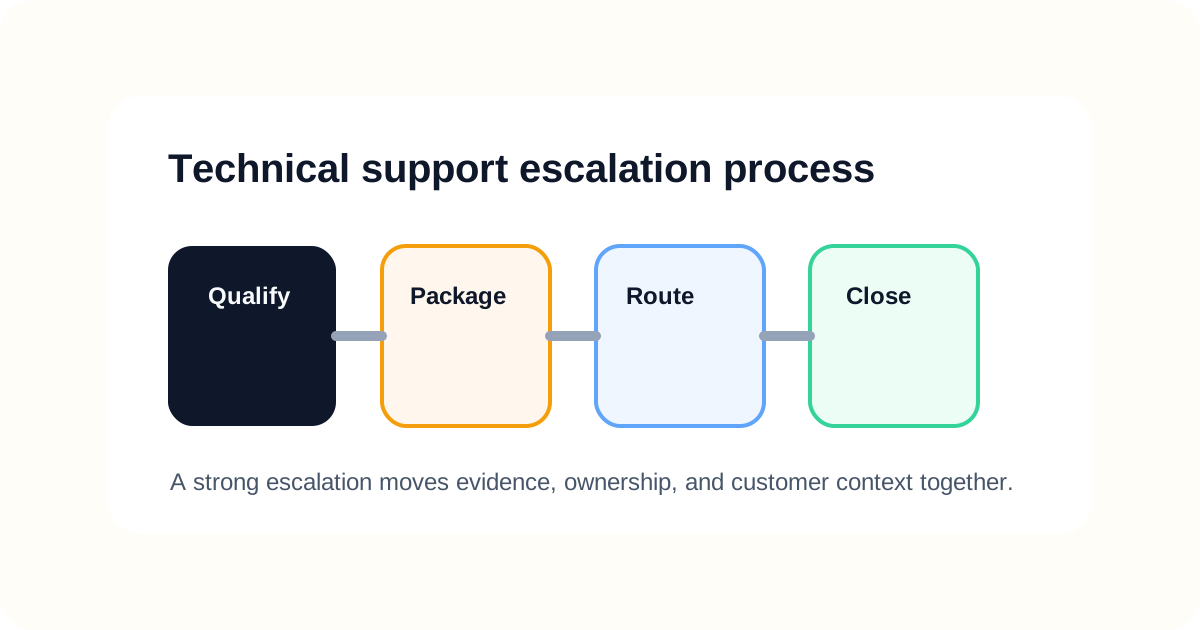
Most technical support escalation processes are built around movement. The better ones are built around readiness. Moving a case to engineering is easy. Moving a case to engineering with enough evidence, context, ownership, and customer framing that the next team can act immediately is the real job.
That distinction matters because escalation is where support systems reveal their design quality. A weak escalation process turns difficult tickets into interrupts. A strong one turns them into clean handoffs.
What is a technical support escalation process?
A technical support escalation process is the structured path a team uses to transfer a case from support to a more specialized owner when the next answer requires deeper product knowledge, broader system access, or change authority that support does not have.
If the process only changes queues, it is incomplete. A real escalation process should increase the receiving team's ability to act immediately.
Step 1: qualify the case before moving it
The first escalation decision should be narrow: does this case actually need escalation?
That question gets skipped all the time. Teams see ambiguity, customer frustration, or a technical symptom and assume engineering should take over. In reality, many so-called escalations are just under-investigated support cases.
Before escalation, support should know:
- what the customer expected;
- what happened instead;
- which account, user, or environment is involved;
- what evidence support already gathered;
- what the most likely explanation is;
- what specific question remains unanswered.
If those basics are not stable, the case is not ready. It is still in investigation.
That is why the support investigation checklist matters so much. It is not separate from escalation quality. It is the precondition for it.
The same idea shows up in incident management guidance. Atlassian's explanation of escalation policies treats escalation as a planned handoff based on severity, scope, ownership, and the kind of expertise needed, not as a vague request for help.
Step 2: package the case like the next team's time matters
Most escalation friction comes from weak case packaging. The support team knows the customer context. Engineering knows the product. If the handoff between those two worlds is thin, both sides repeat work.
A strong escalation packet should be easy to skim and hard to misunderstand.
At minimum, it should include:
- a one-sentence problem summary;
- stable identifiers and timing;
- customer impact and severity;
- evidence already gathered;
- what support ruled out;
- the best current hypothesis;
- the open question or requested action.
| Packet section | Required content | Why it exists | What failure looks like |
|---|---|---|---|
| Problem summary | Expected behavior, actual behavior, affected workflow | Lets the next owner understand the case fast | The receiver has to reconstruct the customer story |
| Context | Account IDs, user IDs, environment, timing | Anchors the investigation | Support and engineering repeat lookup work |
| Evidence | Events, logs, screenshots, checks already performed | Moves facts with the case | The packet contains only narrative and suspicion |
| Customer impact | Blocked workflow, severity, scope, urgency | Improves prioritization and communication | The case is technically described but business context is missing |
| Current hypothesis | Most likely cause plus remaining uncertainty | Improves routing quality | The case reaches engineering with no working theory |
| Open question | What the receiving team must decide or do | Defines the handoff goal | The escalation is vague and ownerless |
Framework table for consistent technical escalation packets.
This is where many vendor narratives about AI support still fall short. They focus on speed, automation, and omnichannel smoothness. The harder operator question is whether the system helps support generate a packet that engineering can trust.
Step 3: route to the right owner, not just a technical queue
A technical support escalation process fails when "send to engineering" is the routing model. Technical work is rarely that simple.
Different cases often need different owners:
- product bugs may belong with product engineering;
- integration failures may belong with a platform or partner team;
- suspicious behavior tied to incidents may belong in incident response;
- permissions, policy, or billing edge cases may belong with support ops or a specialist support function.
The process should answer three things immediately:
- who owns the next internal action;
- who owns customer updates;
- what service expectation applies to this path.
Without that clarity, escalations look slow even when people are working. The issue is not lack of effort. It is lack of a visible operating model.
PagerDuty's escalation policy basics are useful here because they make assignment explicit: incidents move through defined rules until someone acknowledges ownership. Support escalations need the same clarity, even when the case is a customer ticket rather than an infrastructure alert.
Step 4: treat customer communication as part of the process
Escalation is not only an internal state change. From the customer's perspective, it is a trust test.
The team should be able to say:
- what has already been verified;
- what team is now involved;
- what the next milestone is;
- when the customer should expect another update.
That is not the same as promising a resolution time the team cannot defend. It is about making progress legible.
Zendesk and Intercom both emphasize customer experience in modern support. That is correct. The operator detail that matters here is that experience often breaks after escalation, not before it.
Step 5: close the loop back into support
An escalation is not complete when engineering replies in an internal thread. It is complete when the answer is translated back into a customer-safe explanation and the case teaches the system something reusable.
Every closed escalation should record:
- root cause or best available explanation;
- action taken or workaround provided;
- whether support could have solved more of the case earlier;
- whether the investigation path should become reusable workflow.
This is how strong support teams gradually reduce repeat escalations. They do not just resolve tickets. They improve the path the next ticket will follow.
Google's SRE workbook chapter on incident response makes the same operational point from the reliability side: response improves when teams coordinate the work, communicate progress, and learn from previous incidents instead of treating each incident as a one-off event.
| Question | Why it matters | Signal of a weak process |
|---|---|---|
| Was the case escalated at the right time? | Improves qualification discipline | The case moved too early or too late |
| Did the packet contain enough evidence? | Measures escalation readiness | The receiving team asked for missing basics |
| Was ownership clear immediately? | Reduces internal drift | Multiple people watched the case but nobody moved it |
| Did customer communication stay aligned with progress? | Protects trust during slow investigations | The customer learned status from silence |
| Can the case become a reusable workflow? | Turns one-off work into process improvement | The same issue will restart from zero next time |
Framework table for escalation retrospectives and process improvement.
Why escalation quality is one of the best support operations metrics
Support leaders often track volume, SLA, and satisfaction while treating escalation quality like an engineering side issue. That is a mistake.
Escalation quality tells you whether the support system can handle technical uncertainty productively.
Good escalation metrics usually include:
- percentage of escalations returned for missing context;
- time from escalation to named owner;
- customer update miss rate on escalated cases;
- unnecessary escalation rate;
- solve-without-engineering rate on technical tickets.
Those metrics say more about the maturity of the support system than another broad response-time chart.
The escalation process should fit inside the larger support workflow
Escalation is one branch of the workflow, not the whole workflow.
That is why this page fits directly with:
- Build AI support workflows that resolve tickets faster
- L2 support process for technical support teams
- Support escalation management for technical teams
The process works when support investigates first, decides clearly, escalates cleanly, and learns afterward.
That is also where Lumen's angle is different from generic support automation. We care about the quality of the handoff because that is where expensive support work either becomes manageable or keeps leaking into engineering.
FAQ
When should support escalate a technical ticket?
Support should escalate when the next answer depends on deeper product knowledge, system access, or change authority that support does not have, and after the team has already gathered enough evidence to define the real open question.
What should be included in a technical escalation packet?
A strong packet includes the problem summary, identifiers, timing, evidence, customer impact, current hypothesis, and the specific action or answer needed from the receiving team.
Why do escalations feel slow even when teams are responding?
Usually because the case is underpackaged or underowned. The work is happening, but the next owner has to rebuild context before making progress.
How does Lumen think about escalation differently?
We treat escalation as a workflow quality problem, not only a routing problem. If the investigation layer is strong, engineering receives fewer interruptions and the interruptions that remain are better prepared.
Related reading
Continue through the archive
Adjacent articles that expand the same operating model from a different angle: workflow design, investigation quality, and escalation control.
May 15, 2026
AI support metrics that actually matter
Most AI support dashboards reward speed, containment, and cost reduction. The better scorecard measures resolution quality, escalation health, and support autonomy.
May 14, 2026
Support operations for technical tickets
Support operations for technical tickets should define queue design, investigation workflow, escalation quality, and feedback loops that reduce repeat effort.
May 13, 2026
Technical customer support troubleshooting without engineering bottlenecks
Technical customer support troubleshooting works best when support translates symptoms into evidence-backed case decisions before escalation.