Support engineering article
Engineers keep getting pulled into support
Many AI support tools just search the knowledge base and repeat what is already written there. They can help with simple tickets, but they do not help support teams investigate the hard ones, so engineers still get pulled into support.
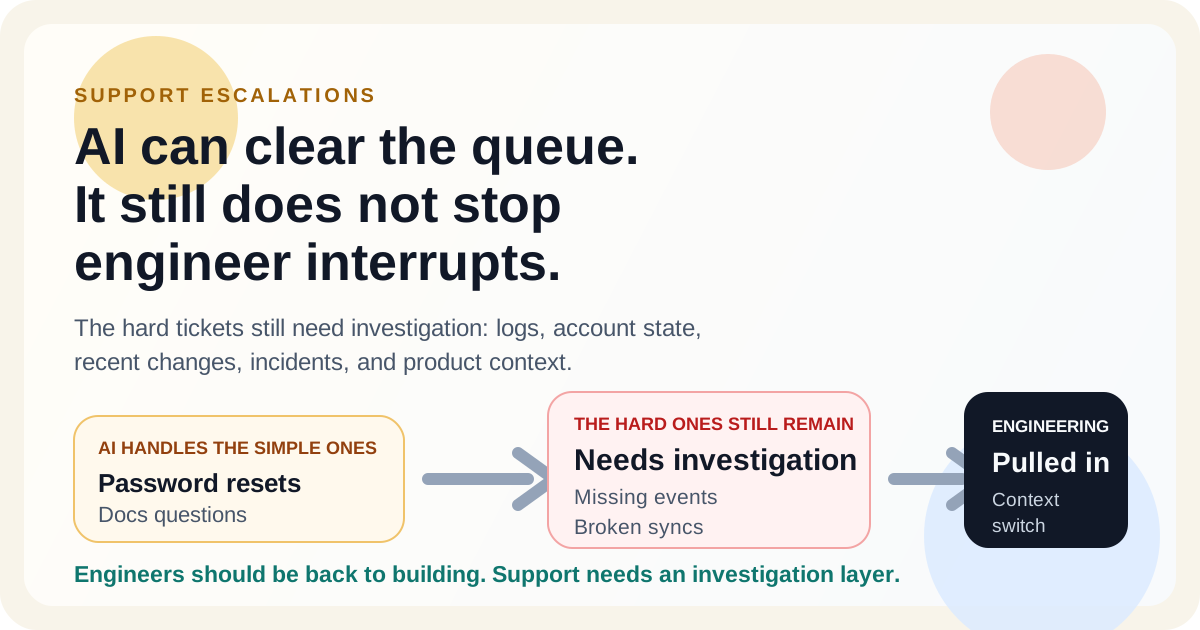
If your engineers keep getting pulled into support, your problem is not just ticket volume. It is that the tickets with the highest investigation cost still have nowhere to go except engineering. Most AI support tools just source the knowledge base and repeat what is already there. That helps with simple questions, but it does not remove the work of tracing logs, checking account state, and explaining product behavior with evidence.
Why easy-ticket automation does not fix the expensive work
Answering password resets and docs questions faster is useful. It can reduce queue volume. But it does not solve the ticket that says "the integration succeeded yesterday and now half our events are missing" or "the API returned 200 and the workflow still failed." Those are the tickets that interrupt engineers, delay product work, and create long internal threads between support and engineering.
When teams say they want AI for support, they often buy a reply layer. What they actually need for this problem is an investigation layer.
What engineers are really doing in support
When a ticket lands with engineering, the engineer usually is not writing a nicer response. They are:
- Reconstructing what the customer was trying to do.
- Pulling logs, account changes, or recent events.
- Comparing expected behavior to actual system behavior.
- Explaining whether the issue is user error, a config problem, a product bug, or an incident.
That work is expensive because it takes product context and it breaks engineering focus. If five engineers each lose just 30 minutes a day to support escalations, that is 12.5 engineering hours every week before you count context switching.
Why current AI support tools still escalate the hardest tickets
Most current tools are optimized for deflection, triage, and response drafting. That is why they look impressive in demos. They close the obvious questions quickly.
The hard tickets are different. To resolve them, the system needs to inspect the product, not just the conversation. If an AI tool cannot connect ticket text to account data, recent actions, known incidents, and past similar cases, it will still hand the ticket to engineering the moment certainty matters.
This is where many teams get misled. Automation numbers improve, but the most expensive escalations barely move.
What has to exist before engineers can stay focused
If you want engineers back to building, support needs a workflow that can do more than draft answers. It needs to:
- Turn messy ticket language into a clear problem statement.
- Pull the right evidence from the systems that explain what happened.
- Show support what is known, what is still uncertain, and what next step makes sense.
- Escalate only when the case truly needs product or code changes.
This is the gap Lumen is built around. Lumen helps support teams investigate technical questions faster so engineering only gets involved when engineering judgment is actually required.
How to tell whether support escalations are still costing you too much
You probably still have the problem if any of these feel familiar:
- Engineers are answering "can you send me the account ID?" more often than they are fixing bugs.
- Support waits on internal Slack threads just to gather basic evidence.
- AI handles the easy tickets, but resolution time for technical cases has barely changed.
- Customers get a fast first response, then wait hours or days for the real answer.
Those signals usually mean your automation is helping with deflection, but not with investigation.
What support should already know before asking engineering
An escalation is not expensive only because it reaches engineering. It is expensive because it often reaches engineering without enough context to be useful.
Before support asks for help, the case should usually already include:
- a clear summary of what the customer was trying to do;
- the affected account, user, or workspace;
- the time window of the failure;
- the evidence support already collected; and
- the exact question engineering needs to answer.
That is why a structured investigation path matters. Even if engineering still has to get involved, the work moves faster when support can hand over a real packet instead of a vague "customer says this is broken." The blog archive will keep expanding this topic cluster with practical workflows and checklists that make those handoffs cleaner.
Engineers should be back to building
The goal is not to remove humans from support. The goal is to remove unnecessary engineering interrupts from support.
If you want a clearer picture of the workflow gap, read the support manifesto and see how Lumen approaches technical investigation for customer support teams. The teams that solve this well do not just automate easy tickets. They give support the context needed to resolve the hard ones.
Related reading
Continue through the archive
Adjacent articles that expand the same operating model from a different angle: workflow design, investigation quality, and escalation control.
May 15, 2026
AI support metrics that actually matter
Most AI support dashboards reward speed, containment, and cost reduction. The better scorecard measures resolution quality, escalation health, and support autonomy.
May 14, 2026
Support operations for technical tickets
Support operations for technical tickets should define queue design, investigation workflow, escalation quality, and feedback loops that reduce repeat effort.
May 13, 2026
Technical customer support troubleshooting without engineering bottlenecks
Technical customer support troubleshooting works best when support translates symptoms into evidence-backed case decisions before escalation.