Support engineering article
Support ticket investigation template for technical cases
A support ticket investigation template should standardize problem statements, evidence, hypotheses, and next actions on technical tickets.
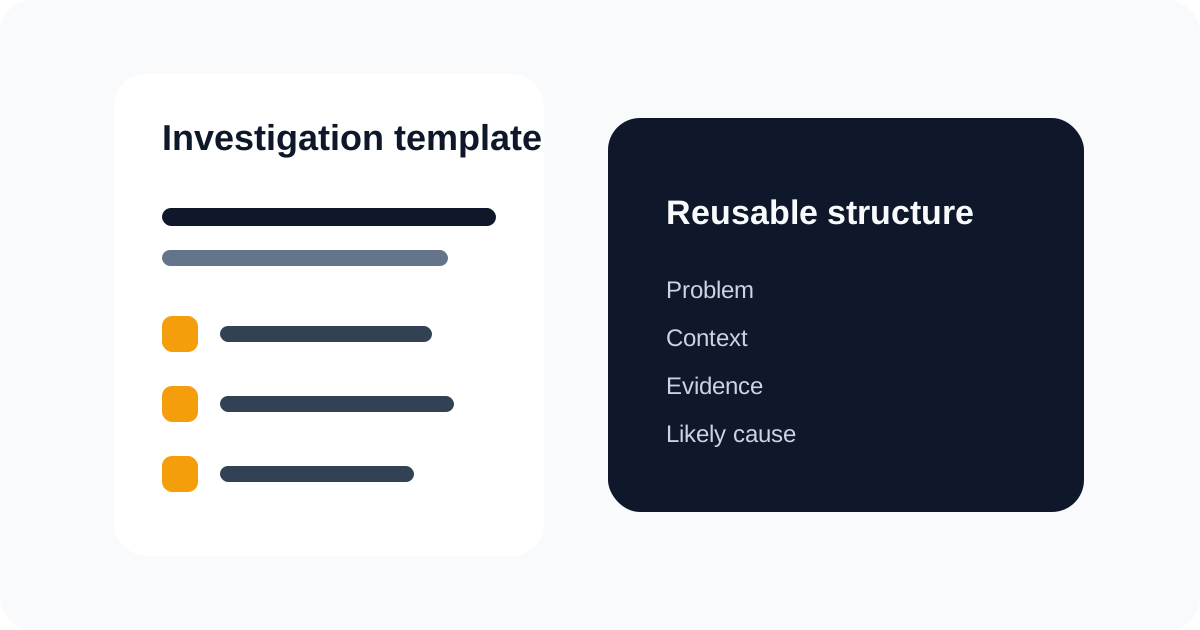
Most technical tickets become expensive because the investigation is not portable. One agent knows the customer context. Another knows the product history. Engineering knows the system behavior. Nobody sees the full case in one durable structure. A good support ticket investigation template fixes that by making the case transferable before the escalation starts.
That is why the template matters more than it first appears. It is not admin overhead. It is the document that decides whether the next person can continue the investigation or has to restart it.
What is a support ticket investigation template?
A support ticket investigation template is a standardized structure for recording a technical case so another operator can understand what happened, what evidence exists, what the likely cause is, and what should happen next.
If the template only captures notes, it is too weak. A useful template captures reasoning and route.
Why technical tickets need a template in the first place
Support teams often think the problem is missing tools. Usually the problem is missing structure.
Without a template:
- the case summary changes shape every time;
- evidence gets trapped in chat and side threads;
- hypotheses stay implicit;
- engineering receives the customer story without the reasoning behind it.
That is how escalations become slow. The receiving team is not only solving the issue. It is reconstructing the investigation.
This is especially visible in technical B2B products, where context lives across account state, logs, integrations, permissions, and recent changes. The cost of poor case structure compounds quickly.
Google's SRE chapter on effective troubleshooting is a useful reference point because it starts with the quality of the problem report: expected behavior, actual behavior, reproducibility, and a searchable record. That is exactly what a support investigation template should preserve.
Section 1: problem statement
The template should open with one short sentence that compares expected behavior with actual behavior.
That means the first line should usually include:
- the affected workflow;
- the expected outcome;
- the actual outcome;
- any important time boundary.
If the team cannot write that clearly, the investigation is not ready.
This is also why the support investigation checklist should usually come before the final template. The checklist helps the team decide what belongs in the template. The template makes the finished case portable.
Section 2: operational context
The next section should anchor the issue inside the product so another person can continue without hunting for basics.
Useful fields usually include:
- account or workspace ID;
- affected user or integration reference;
- environment, plan, or feature flag context;
- reproduction status;
- relevant timing and recent changes.
This is not busywork. It is what keeps the next owner from reopening the same discovery loop.
GitHub's docs on viewing webhook deliveries show why this matters in practice. A useful technical record includes the request, response, timestamp, and delivery details, not just a human summary that something failed.
Section 3: evidence collected
This section should capture what the investigator actually observed.
That might include:
- product events;
- logs or system traces;
- configuration mismatches;
- state checks;
- incident or deploy review results.
The key rule is simple: separate evidence from interpretation.
For example:
- evidence: webhook attempts returned repeated 503 responses;
- interpretation: the downstream endpoint is likely unavailable or rejecting traffic.
That separation makes collaboration faster and makes escalation packets more trustworthy.
This is also how strong technical documentation teaches troubleshooting. GitHub's webhook troubleshooting guide separates failure types such as missing deliveries, invalid responses, timeouts, and signature verification failures so the next action follows the evidence.
| Section | What it should contain | Why it matters | What goes wrong without it |
|---|---|---|---|
| Problem statement | Expected vs actual behavior in one sentence | Anchors the whole case | The team keeps interpreting the ticket differently |
| Operational context | Identifiers, environment, timing, recent changes | Makes the case reproducible internally | The next owner restarts basic lookup work |
| Evidence | Verified observations, logs, screenshots, state checks | Moves facts with the case | Conclusions travel without proof |
| Current hypothesis | Best explanation plus open uncertainty | Improves routing and review quality | The case remains vague and ownerless |
| Next action | Explain, workaround, escalate, monitor, or request more info | Turns the template into workflow | The document records the past but does not guide the future |
Framework structure for building portable technical support cases.
Section 4: current hypothesis
Many teams skip this section because they do not want to sound overconfident. That caution is understandable. It is still a mistake.
Every technical case should carry:
- the most likely explanation right now;
- alternate explanations still in play;
- the missing fact that would resolve the uncertainty.
The goal is not certainty. The goal is progress.
Without a stated hypothesis, the next owner has to infer the reasoning from scattered checks. That slows the investigation and weakens the escalation packet.
Section 5: explicit next action
The last section should make the route unambiguous.
Possible next actions include:
- send a customer explanation;
- apply or recommend a workaround;
- escalate to engineering or another specialist owner;
- shift to incident handling;
- request one missing piece of customer information.
This turns the template from a record into an operating object.
That is why the template connects directly to Support escalation management for technical teams and Technical support escalation process for complex tickets. A strong template becomes the raw material for a strong escalation.
What makes a template usable instead of annoying
Most failed template rollouts are too long, too generic, or too detached from real workflows.
The best templates share a few traits:
- they are short enough to complete during real ticket work;
- they force evidence and hypothesis into separate fields;
- they make the next action explicit;
- they are reviewed against actual escalations, not admired in documentation.
That last part matters. A template that looks comprehensive but does not improve case transfer is just formatting.
How templates improve support operations, not just documentation
A good investigation template helps with more than individual tickets.
It improves:
- escalation quality;
- L2 consistency;
- onboarding for new technical support agents;
- AI workflow design, because the system has a clearer case structure;
- repeat-case learning, because comparable tickets share the same shape.
This is one reason the template is operationally important in AI-assisted support. Vendors can generate replies, summaries, and handoff notes. The harder problem is whether the support organization has a stable object for the model to reason over.
How to introduce a template without slowing the queue down
Start with one high-friction ticket class and keep the first version small.
Ask:
- did another operator understand the case faster;
- did escalation quality improve;
- did engineering ask fewer repeated context questions;
- did customer explanations become clearer.
If those answers improve, the template is doing real work.
The template should sit inside the larger investigation system
A template is not the whole answer. It becomes useful when it fits inside a larger operating model that also includes:
- a checklist for what to verify;
- an L2 process for who owns the investigation;
- an escalation process for when deeper ownership is needed.
That is the larger cluster Lumen is building because technical support usually breaks at the boundaries between those layers, not inside one of them alone.
FAQ
What should a support ticket investigation template include?
At minimum, it should include the problem statement, identifiers and timing, verified evidence, current hypothesis, and explicit next action. If any of those are missing, the case is usually harder to transfer cleanly.
How is a template different from a checklist?
The checklist guides the investigation sequence. The template captures the resulting case in a portable format. They work together, but they solve different problems.
Why do templates improve escalation quality?
Because they force support to move context, evidence, and the open question together. That reduces the amount of reconstruction the receiving team has to do before making progress.
How does Lumen think about templates differently?
We treat the template as part of the operating system, not as documentation polish. A strong case object makes AI assistance, L2 work, and escalations all more effective.
Related reading
Continue through the archive
Adjacent articles that expand the same operating model from a different angle: workflow design, investigation quality, and escalation control.
May 15, 2026
AI support metrics that actually matter
Most AI support dashboards reward speed, containment, and cost reduction. The better scorecard measures resolution quality, escalation health, and support autonomy.
May 14, 2026
Support operations for technical tickets
Support operations for technical tickets should define queue design, investigation workflow, escalation quality, and feedback loops that reduce repeat effort.
May 13, 2026
Technical customer support troubleshooting without engineering bottlenecks
Technical customer support troubleshooting works best when support translates symptoms into evidence-backed case decisions before escalation.