Support engineering article
Support escalation management for technical teams
Support escalation management should combine severity, routing, ownership, evidence quality, and customer communication into one operating system.
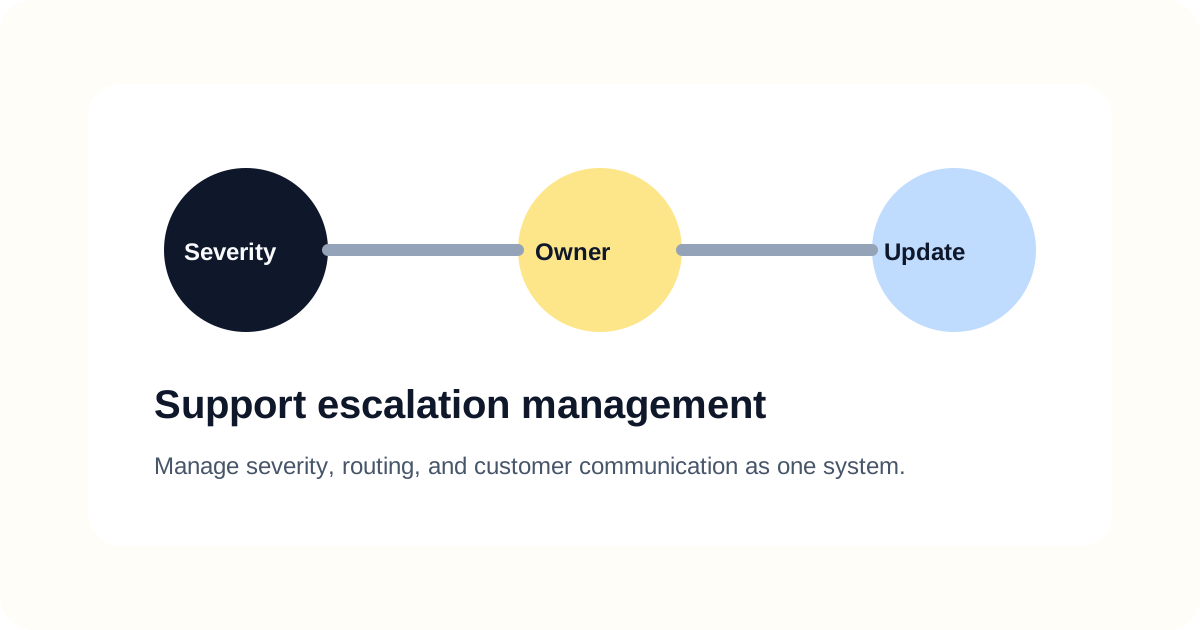
Support escalation management is not a queueing problem dressed up with alerts and severity labels. It is a coordination system. When a technical case becomes serious enough to escalate, the team has to align urgency, ownership, evidence, and customer communication fast. If those four things move separately, the escalation feels chaotic even when good people are involved.
That is why many escalation systems break under pressure. They were designed to move cases upward, not to keep the whole organization synchronized around them.
What is support escalation management?
Support escalation management is the operating model a team uses to coordinate high-risk or technically complex cases across investigation, routing, ownership, and communication. It is broader than the escalation packet. It includes how the case is prioritized, who is accountable, and how customers are kept informed while the work is still in progress.
If the process begins only after the case is already bouncing between teams, it began too late.
Severity should change the workflow, not decorate it
Many teams assign severity labels that do not actually alter behavior. That creates noise, not control.
A useful severity model should change:
- who must be involved;
- how quickly an owner must be named;
- how often the case should be reviewed internally;
- what customer update cadence is expected;
- whether the case stays in support, enters incident handling, or moves to a specialist owner.
Without those workflow changes, severity is just metadata.
That is one reason support leaders often feel dissatisfied with their escalation process. The labels look mature. The operating response underneath them is inconsistent.
Atlassian's guidance on major incident management is a useful model here because severity is tied to a sequence of operational actions: assess, communicate, escalate, delegate, review, and resolve. Support escalations need the same kind of behavior behind the label.
Ownership needs to be explicit immediately
Escalations slow down when many people are aware of the case but nobody is clearly accountable for the next action.
Good escalation management answers three questions early:
- who owns the internal investigation;
- who owns customer communication;
- who has authority to change the route if the case expands.
These are not the same role by default. In stronger teams, the internal owner and the customer-facing owner may be different people. What matters is that both are named.
That clarity becomes even more important in distributed or asynchronous support organizations where cases can drift across shifts and time zones.
PagerDuty's documentation on incidents makes the ownership point plainly: acknowledgement means someone has claimed the issue and the escalation behavior changes. Support teams need an equivalent moment when a customer escalation stops being watched and starts being owned.
Evidence quality is what determines escalation speed
A poorly prepared case will move slowly no matter how strong the engineering team is. The receiving owner will need to reconstruct the timeline, find the basic identifiers, rerun the first checks, and reframe the customer problem before real investigation starts.
That is why support escalation management depends so heavily on the upstream workflow described in Technical support escalation process for complex tickets. A strong process packages the case before it moves. A weak one shifts the cost of investigation downstream.
The same principle explains why many AI support programs disappoint on harder tickets. They improve drafting and triage while leaving evidence collection and case packaging mostly unchanged.
| Component | What strong looks like | What weak looks like | Operational consequence |
|---|---|---|---|
| Severity | Labels trigger clear workflow changes | Labels are inconsistent or mostly decorative | Teams overreact to some cases and underreact to others |
| Ownership | Internal and customer-facing owners are named quickly | Everyone is aware but nobody is accountable | Cases drift between teams |
| Evidence quality | Escalations include context, facts, and open question | Packets are vague or incomplete | Receiving teams restart the work |
| Customer communication | Updates are tied to real milestones and timing | Updates happen ad hoc | Trust drops during slower investigations |
| Route control | The team knows when to switch paths or widen the response | The case stays in the wrong workflow too long | Urgency grows before structure catches up |
Framework table for diagnosing weak support escalation management systems.
Customer communication is part of escalation management, not an afterthought
One of the biggest management failures is treating escalation as an internal event only.
From the customer's perspective, escalation changes the support experience immediately. They now care about:
- whether the company understands the issue;
- whether the right team is actually involved;
- whether the next update will say something meaningful;
- whether the silence means drift or real progress.
That means a good escalation management loop must keep support equipped to communicate:
- what is known;
- what is being investigated;
- what the next milestone is;
- when the customer will hear from the team again.
The message does not need to sound polished first. It needs to sound informed and controlled.
Atlassian's incident response handbook emphasizes follow-up communication because it creates a shared source of truth while information is still scarce. The same principle applies to customer support escalations: updates should reduce uncertainty, not merely prove that someone replied.
Where support escalation management usually fails
The pattern is predictable:
- severity is inconsistent;
- ownership is implicit;
- the internal packet is too thin for the next team to act;
- support and engineering run separate timelines;
- customers receive updates only when someone remembers.
These are workflow design failures. They are rarely effort failures.
That is why a support team can have caring people, responsive managers, and still produce a bad escalated experience. The operating model is doing too little work.
What to measure if you want the system to improve
Support escalation management is measurable. Teams often just choose weak metrics.
| Metric | Definition | Why it matters | Failure signal |
|---|---|---|---|
| Time to named owner | Time from escalation to explicit internal ownership | Shows whether the case is controlled quickly | Many people are aware before anyone is accountable |
| Customer update miss rate | Share of escalations where the expected update window is missed | Protects trust during long investigations | Customers experience silence instead of progress |
| Escalation rework rate | Share of escalations returned for missing context | Measures packet quality | The receiving team asks for basics already known upstream |
| Severity mismatch rate | Share of cases reclassified after initial escalation | Shows whether severity rules are usable | Teams misjudge urgency or impact repeatedly |
| Avoidable escalation rate | Share of escalations that support could have solved with a stronger process | Exposes upstream workflow gaps | L2 and investigation systems are too weak |
Framework metrics for improving escalation coordination and control.
That last metric matters more than many teams expect. If too many cases escalate unnecessarily, the real problem may sit earlier in the workflow, especially in the L2 layer described on L2 support process for technical support teams.
Why technical products need a stricter escalation management model
Technical products create escalations that are more ambiguous, more cross-functional, and more expensive than simple support cases.
The team is not just managing volume. It is managing uncertainty around:
- product behavior;
- infrastructure stability;
- integration state;
- account-specific edge cases;
- business impact.
That is why the lightweight escalation models that work for general customer service often break in B2B technical support.
Lumen's view is straightforward here: technical escalations need an investigation-first operating system. Otherwise the company keeps spending senior attention on rebuilding context rather than solving the issue.
Support Driven's conversation on scaling support for enterprise SLAs is a useful practitioner reference because it connects severity levels, customer expectations, and support-engineering alignment in enterprise support operations.
The best teams design escalation management as a system
The strongest teams do not rely on heroics. They design a system in which:
- severity changes workflow;
- ownership is explicit;
- evidence moves with the case;
- customer communication follows real milestones;
- post-case review improves the next escalation.
That is how escalation stops feeling like chaos and starts feeling like controlled response.
FAQ
What is the difference between escalation process and escalation management?
The process describes how a case moves and what information it carries. Management describes how severity, ownership, communication, and control are coordinated around that process while the case is still active.
What breaks first in weak escalation management?
Usually ownership and communication. The team may still be working, but the case feels slow because nobody is clearly accountable for the next step and the customer cannot see structured progress.
Which metric is the best early warning signal?
Time to named owner is one of the strongest early signals because it tells you whether the escalation is becoming controlled quickly or drifting while the team tries to figure out who should move it.
How does Lumen think about escalation management differently?
We treat it as a workflow-quality problem rooted in investigation readiness. Better coordination matters, but the biggest gains usually come from stronger context and evidence before the case becomes urgent.
Related reading
Continue through the archive
Adjacent articles that expand the same operating model from a different angle: workflow design, investigation quality, and escalation control.
May 15, 2026
AI support metrics that actually matter
Most AI support dashboards reward speed, containment, and cost reduction. The better scorecard measures resolution quality, escalation health, and support autonomy.
May 14, 2026
Support operations for technical tickets
Support operations for technical tickets should define queue design, investigation workflow, escalation quality, and feedback loops that reduce repeat effort.
May 13, 2026
Technical customer support troubleshooting without engineering bottlenecks
Technical customer support troubleshooting works best when support translates symptoms into evidence-backed case decisions before escalation.