Support engineering article
L2 support process for technical support teams
A strong L2 support process turns ambiguous technical tickets into evidence-backed decisions before engineering gets interrupted.
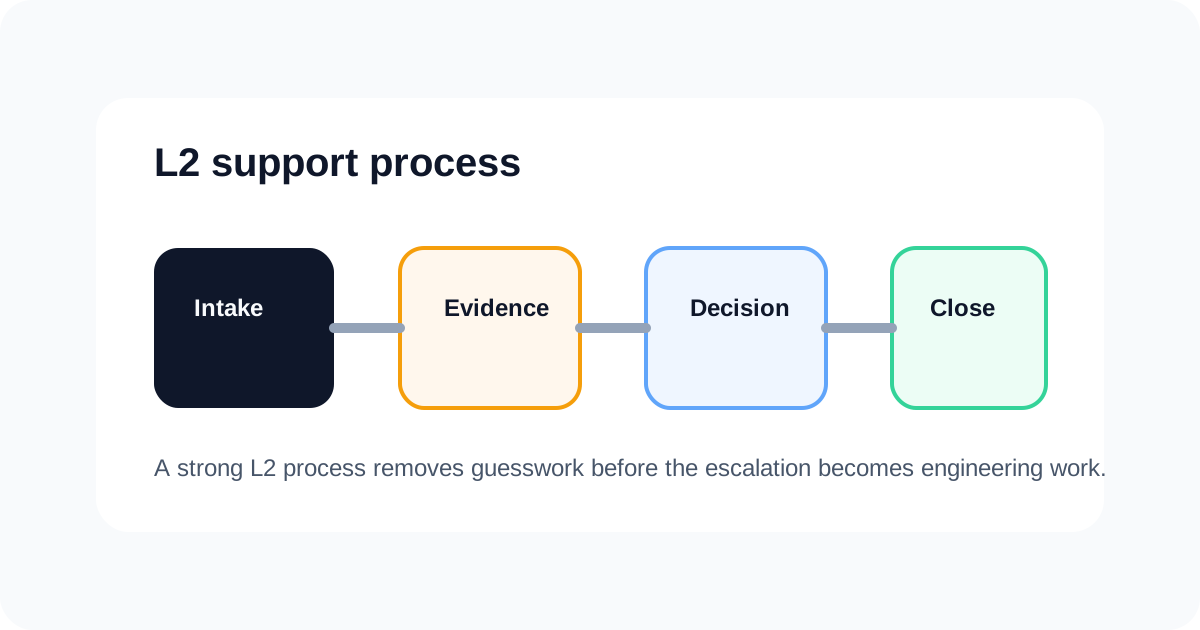
Most L2 teams are treated like overflow queues with better product knowledge. That is too shallow. A real L2 support process is not just a place for harder tickets to wait. It is the decision layer that absorbs technical ambiguity before engineering has to absorb it.
That distinction matters because many support organizations think they have an L2 problem when they really have a process problem. The tickets are not failing because they reached the wrong people. They are failing because nobody owns the investigation path strongly enough before escalation.
What is L2 support supposed to do?
L2 support sits between frontline support and engineering. Its job is to turn unclear technical reports into evidence-backed decisions. Sometimes that decision is a customer explanation. Sometimes it is a workaround. Sometimes it is a clean escalation. The common thread is that the ambiguity gets reduced before the next handoff.
If L2 is only acting as a more technical inbox, the process is underdesigned.
Why L2 exists in the first place
Technical tickets usually become expensive for one reason: uncertainty.
The customer reports a symptom. Frontline support does not yet know:
- whether the behavior is expected;
- whether the issue is account-specific or broader;
- whether the evidence points to configuration, product behavior, or defect;
- whether the case really deserves engineering attention.
L2 exists to resolve that uncertainty faster and more consistently than ad hoc internal collaboration can.
That makes L2 a process role, not just a seniority label.
This maps closely to how Google SRE describes troubleshooting as a teachable process, not an innate trait. The Effective Troubleshooting chapter is useful because it separates generic debugging discipline from system-specific knowledge; L2 support needs both.
Step 1: intake should stabilize the case
An L2 process starts by making the ticket legible.
The team should be able to state:
- what the customer tried to do;
- what happened instead;
- which account, user, or environment matters;
- when the issue happened;
- what the frontline team already checked.
Without that baseline, the rest of the process becomes undirected searching.
This is why the support investigation checklist is not just a nice companion resource. It is part of the actual L2 system. A weak intake means L2 spends time reconstructing the ticket instead of investigating it.
Step 2: gather evidence, not just more data
L2 work gets confused with raw access all the time. Teams assume that if L2 has more dashboards and more logs, the process is solved.
It is not.
The better question is whether L2 can gather the minimum useful evidence needed to confirm or reject the most likely explanations.
That often includes:
- recent account or configuration changes;
- relevant product events and system traces;
- known incidents or recent deploys;
- permissions, plan, or environment state;
- comparable prior cases.
The operator mistake is confusing more data with more clarity. Strong L2 teams know how to narrow faster.
In webhook-heavy products, for example, GitHub's troubleshooting guide shows the kind of narrowing L2 should do: determine whether a delivery was missing, delayed, rejected, timed out, or failed verification before deciding whether the next owner is support, the customer, or engineering.
Step 3: classify the case before choosing the route
The point of L2 is not only to know more. It is to decide better.
After the evidence review, the team should be able to separate:
- expected behavior that needs explanation;
- configuration or workflow errors that need correction;
- temporary platform issues that need monitoring and communication;
- product defects or deeper issues that need escalation.
That classification step is where support autonomy is built.
| Case type | Primary L2 action | Best next step | When engineering should join |
|---|---|---|---|
| Expected behavior | Explain findings with evidence | Send a customer-safe clarification | When the product interpretation remains unclear |
| Configuration issue | Identify the setup mismatch | Guide the customer or internal owner to the correction | When support lacks the access to finish the fix |
| Temporary platform issue | Verify scope and timing | Communicate status and monitor | When incident handling becomes necessary |
| Product defect | Package evidence and impact | Escalate with a clear hypothesis | As soon as defect likelihood is credible |
Framework table for L2 decisioning on technical support cases.
This is where many AI support programs disappoint. They improve drafting and triage, but the decision layer still depends on scattered human judgment instead of a defined investigation path.
Step 4: separate explanation, workaround, and escalation
A mature L2 process does not force every nontrivial ticket into the same outcome. It knows the difference between:
- explaining a confusing but valid product behavior;
- providing a workaround for a known edge case;
- escalating a case that truly requires deeper ownership.
That distinction matters for customer trust. The wrong escalation path can make the company look slower than it is. The wrong explanation path can make the company look careless.
This is why L2 should not be measured only by closure volume. It should be measured by decision quality.
Step 5: close the case in a reusable way
L2 should create leverage beyond the current ticket.
Every resolved technical case should leave behind:
- the best explanation available;
- the evidence that supported the answer;
- the next-step logic that determined the route;
- any reusable workflow or playbook that should help the next similar case.
Without this step, L2 becomes a high-skill queue with low organizational memory.
This is the support version of toil reduction. Google's SRE workbook on eliminating toil argues for identifying and measuring repetitive operational work so teams can remove it at the source. L2 closeout should do the same for repeat technical support patterns.
That is one reason the Build AI support workflows that resolve tickets faster page matters. The workflow only compounds if the learning path is explicit.
What weak L2 processes look like in practice
The failure mode is easy to recognize:
- every case starts with the same repeated internal questions;
- nobody can tell whether a case has enough evidence;
- escalations reach engineering with vague summaries;
- the real system of record lives in internal chat, not in the case;
- customers wait while ownership remains ambiguous.
That is expensive even when volume looks manageable. It creates hidden rework, context switching, and low confidence in the final answer.
How to measure whether L2 is actually working
The useful metrics are more operational than cosmetic.
| Metric | Definition | Why it matters | Typical failure signal |
|---|---|---|---|
| Time to first evidence | Time from L2 assignment to first verified internal finding | Shows investigation efficiency | Cases sit idle before any concrete progress |
| Solve-without-engineering rate | Share of L2 cases closed without engineering help | Measures support autonomy | Most hard cases still become engineering interrupts |
| Escalation rework rate | Share of escalations returned for missing context | Measures packet quality | Receiving teams ask for identifiers, timeline, or basics |
| Repeat-case workflow capture | Count of resolved patterns converted into reusable process | Shows whether L2 creates organizational leverage | The same issue keeps starting from zero |
| Decision reversal rate | Share of cases that were routed incorrectly after L2 review | Measures classification quality | The process narrows slowly or unreliably |
Framework metrics for L2 support operations. These are suggested instrumentation points, not benchmark values.
These metrics tell you whether L2 is absorbing ambiguity productively or simply delaying the same escalation by another queue hop.
Why L2 matters more in AI-assisted support
AI makes the difference between easy and hard tickets more visible. Once simple requests are handled faster, the remaining human work becomes more concentrated around ambiguity, investigation, and edge cases.
That means L2 becomes more important, not less.
Intercom, Zendesk, and Ada all help normalize AI in support. The operator gap is that many teams still need a clearer model for what happens after the FAQ layer. L2 is the answer to that gap when it is treated as a structured investigation function.
The best L2 process protects engineering focus
The point of L2 is not to eliminate engineering involvement entirely. Some cases should reach engineering. The point is to make sure engineering receives fewer cases and better cases.
That is the same operating goal behind:
- Technical support escalation process for complex tickets
- AI support automation vs investigation: what actually reduces escalations
- Support escalation management for technical teams
When L2 works well, support becomes more autonomous, escalations become more precise, and the customer gets a stronger answer sooner.
FAQ
What is the main purpose of L2 support?
The main purpose of L2 support is to reduce technical ambiguity before engineering gets involved. That means investigating, classifying, explaining, and escalating only when the remaining gap truly requires it.
How is L2 different from frontline support?
Frontline support handles broader intake and simpler resolutions. L2 handles the tickets where evidence gathering, internal context, and stronger routing discipline are needed before the team can answer safely.
What is the clearest sign that an L2 process is weak?
Engineering still receives vague technical escalations that require basic context gathering before real investigation can start. That usually means L2 is functioning as a forwarding layer instead of a decision layer.
How does Lumen think about L2 differently?
We treat L2 as the place where investigation quality should become operational. If that layer is strong, support can close more technical tickets without depending on engineering for routine clarification.
Related reading
Continue through the archive
Adjacent articles that expand the same operating model from a different angle: workflow design, investigation quality, and escalation control.
May 15, 2026
AI support metrics that actually matter
Most AI support dashboards reward speed, containment, and cost reduction. The better scorecard measures resolution quality, escalation health, and support autonomy.
May 14, 2026
Support operations for technical tickets
Support operations for technical tickets should define queue design, investigation workflow, escalation quality, and feedback loops that reduce repeat effort.
May 13, 2026
Technical customer support troubleshooting without engineering bottlenecks
Technical customer support troubleshooting works best when support translates symptoms into evidence-backed case decisions before escalation.